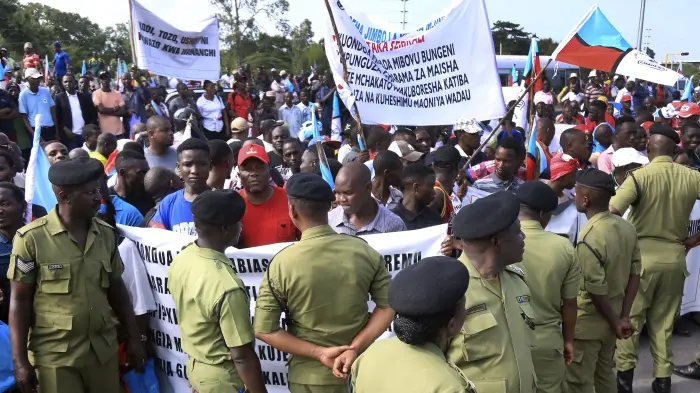
Young demonstrators have seized control of major public spaces — including airports — in protest against what they call a “sham election” that solidifies the rule of President Samia Suluhu Hassan. Reports show widespread anger in cities such as Dar es Salaam, where protesters have mobilised to prevent leaders or officials from leaving the country. Many are chanting that no leader will escape, demanding accountability and democratic reform.
Authorities have simultaneously imposed a nationwide internet blackout, cutting access to social media, messaging apps, and international communications — a move widely seen as curtailing transparency in real time, according to Reuters.
Context: Contested Election and Concentration of Power
Tanzania held general elections on 29 October 2025, including a presidential race. The electoral process has been heavily criticised by international observers after two leading opposition candidates — from Chadema and ACT-Wazalendo — were either disqualified or detained. Party leader Tundu Lissu was arrested on treason charges shortly before polling day, in what rights groups described as a politically motivated move.
The incumbent, President Samia Suluhu Hassan of the ruling Chama Cha Mapinduzi (CCM), was declared winner with approximately 97.66% of the vote, according to official tallies, with voter turnout reported at about 87% of 37.6 million registered voters, Reuters reported.
Escalation: Protests, Crackdowns, and Communication Blackout
Protests erupted almost immediately after polls closed. In Dar es Salaam, demonstrators defied a government-imposed curfew, clashing with police forces that deployed tear gas and, in some reports, live ammunition. Al Jazeera confirmed that several protesters were injured in the confrontations.
The government subsequently ordered civil servants to stay home and deployed additional troops across strategic transport routes. Flights were disrupted at Julius Nyerere International Airport, while roadblocks were erected on highways leading to the capital. News24 reported that a national curfew remains in place amid fears of rising casualties.
The internet blackout — which extends to messaging platforms and international networks — continues to hinder communication, blocking real-time reporting and coordination among activists. AP News notes that the government justified the move by alleging “cyberattacks” on state platforms, a claim digital rights groups dispute.
Voices of Dissent: Youth Mobilisation and Civic Demands
Much of the resistance is being led by Tanzania’s youth, who have become the visible face of the protests. Many young citizens accuse the government of eroding democratic freedoms and denying them a voice in the political process. Observers describe the movement as largely organic — youth-driven rather than partisan — drawing power from digital networks before the internet shutdown, according to AP News.
Protesters insist that the election “was not an election at all,” citing the absence of opposition and the alleged manipulation of the National Electoral Commission. Calls for democracy, transparency, and fair governance dominate the demonstrations, despite heavy-handed security responses documented by The Guardian.
Impartial Assessment: Tensions Between Order and Legitimacy
The unfolding events underscore Tanzania’s delicate balance between constitutional order and democratic legitimacy. While the ruling party insists it followed lawful electoral procedures, widespread arrests of opposition figures and the suppression of communication have undermined confidence in the outcome. The internet shutdown, condemned by international observers, further entrenches perceptions of authoritarianism.
Human rights monitors and civic groups, including Le Monde Afrique, warn that Tanzania’s democracy is at risk of regression if dialogue, transparency, and political pluralism are not restored.
Conclusion: A Crossroads for Tanzania’s Democracy
Tanzania stands at a critical juncture. The official declaration of victory has done little to calm unrest, and the deployment of military forces suggests the government is prioritising control over consensus. The country’s youth — increasingly mobilised, educated, and connected — represent a powerful constituency demanding accountability.
Restoring public trust will require more than a declaration of results. It will depend on lifting the internet blackout, ensuring independent verification of votes, and engaging citizens in genuine political dialogue. Without these measures, Tanzania risks deepening instability and alienating a generation determined to reclaim its democratic future.