
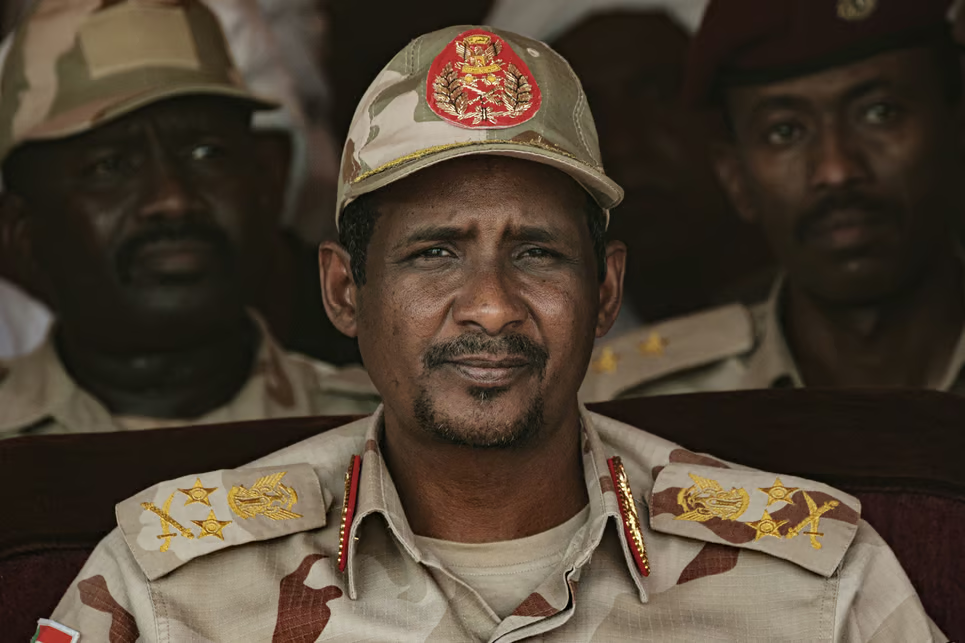
The collapse of order in Sudan and the rise of the RSF demand nuanced scrutiny. While external actors — notably the United Arab Emirates (UAE) — receive increasing attention, the conflict’s roots and dynamics cannot be reduced to a single foreign sponsor or external intervention. This piece examines key historical developments, major actors and their motivations, and implications for Sudan’s future.
Origins of the RSF: From Janjaweed to paramilitary powerhouse
The RSF traces its lineage to the armed Arab‑tribal militias commonly known as the Janjaweed, mobilised in the early 2000s in Darfur to suppress rebel movements and carry out widespread atrocities, including ethnic cleansing of non‑Arab African‑descent communities. In 2013, Sudan’s regime formalised the RSF as a paramilitary force. According to Encyclopaedia Britannica, in 2017 a law legitimised the RSF as an independent security force under state command.
Under the leadership of Mohamed Hamdan Dagalo (often called “Hemedti”), the RSF expanded significantly in capacity and influence.
Institutional entanglement: The RSF, the state and the war economy
The RSF was initially a tool of the Sudanese state but evolved into a powerful actor autonomously. Its creation was part of President Omar al‑Bashir’s strategy to suppress insurgencies. The group amassed substantial economic interests, including control of gold mining regions in Darfur and elsewhere, allowing it to finance itself outside direct state oversight.
This autonomy produced friction with the state’s regular military—the Sudanese Armed Forces (SAF)—ultimately culminating in open war in April 2023.
External partnerships and sources of support
External actors have facilitated the RSF’s reach and longevity. The UAE is among the most cited, with reports from human‑rights organisations, UN panels and investigative outlets indicating the RSF’s leadership has used Emirati‑linked gold trading, weapons procurement and logistic networks. At the same time, Russia (via the Wagner Group) is implicated in supporting both infrastructure and mining deals tied to Sudan’s wartime economy.
However, it is inaccurate to present the UAE as the sole actor or originator of the conflict. The domestic roots of the RSF and Sudan’s war structures must be maintained in view.
Why mis‑characterisations matter
Public discourse sometimes frames Sudan’s conflict as primarily a “foreign war‑by‑proxy,” reducing agency to external sponsors and overlooking domestic politics, ethnic tensions and structural drivers. Such a depiction distorts accountability and risks misdirecting policy responses.
- The RSF’s origins lie in Sudan’s internal sectarian and tribal mobilisations—its formation, institutionalisation and economic foundations emerged within the state.
- The wartime logic of Darfur, the consolidation of patronage networks and the extraction industries occurred within Sudan’s state‑society nexus.
- External actors are enablers—but not architects—of the war. Recognising this helps direct reform towards internal power‑structures, not just external embargoes.
Implications and next steps
- Domestic reform remains essential: Restructuring Sudan’s security architecture, reducing extractive economic monopolies (e.g., gold mines, land deals) and dismantling the patronage model undergirding the RSF are prerequisites for lasting peace.
- External leverage is still relevant: While not the root cause, arms flows and financial facilitation from abroad enable the conflict’s continuation. Active enforcement of arms embargoes and financial transparency are necessary.
- Ethnic justice and reconciliation must be central: The RSF’s operations are tied intimately to the Arab‑nomadic vs. African‑descent divide in Darfur and elsewhere. Lasting resolution requires meaningful inclusion, justice for forced displacements and addressing long‑standing structural inequality.
- Humanitarian responses must shift to structural interventions: Relief remains vital, but without addressing root economic and political drivers, the cycle of violence is likely to persist.
Conclusion
The crisis in Sudan is fundamentally Sudanese—a product of internal state–militia relations, extractive war‑economies, ethnic exclusion and institutional failure. External actors such as the UAE play one enabling role among many, but they are not the architects of the conflict. A comprehensive response must acknowledge both internal and external dimensions of power and accountability. Without this dual approach, efforts risk repeating the patterns of violence rather than breaking them.